Neoclassical language & authorship
Planned as the focal point of L'Enfant's city, the Capitol broadcasts American neoclassicism—temple fronts, porticoes, and a commanding dome—to link the young republic to Rome. The sequence of architects set that language: William Thornton's 1793 scheme established the central massing; Benjamin Henry Latrobe rebuilt interiors and introduced robust classical detailing; Charles Bulfinch completed the early building with a low copper-clad dome. Mid-century growth brought Thomas U. Walter (with August Schoenborn) to design larger House and Senate wings and the present dome, completed under Edward Clark.
Neoclassical language & authorship
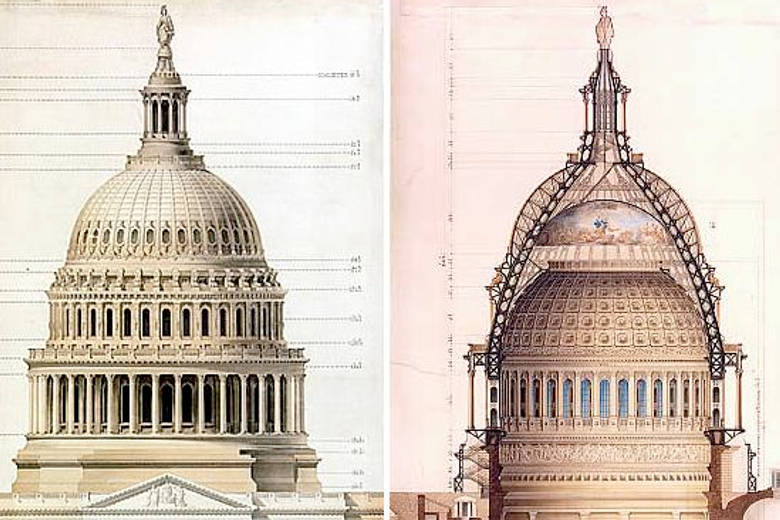
Planned as the focal point of L'Enfant's city, the Capitol broadcasts American neoclassicism—temple fronts, porticoes, and a commanding dome—to link the young republic to Rome. The sequence of architects set that language: William Thornton's 1793 scheme established the central massing; Benjamin Henry Latrobe rebuilt interiors and introduced robust classical detailing; Charles Bulfinch completed the early building with a low copper-clad dome. Mid-century growth brought Thomas U. Walter (with August Schoenborn) to design larger House and Senate wings and the present dome, completed under Edward Clark.
Neoclassical language & authorship
Planned as the focal point of L'Enfant's city, the Capitol broadcasts American neoclassicism—temple fronts, porticoes, and a commanding dome—to link the young republic to Rome. The sequence of architects set that language: William Thornton's 1793 scheme established the central massing; Benjamin Henry Latrobe rebuilt interiors and introduced robust classical detailing; Charles Bulfinch completed the early building with a low copper-clad dome. Mid-century growth brought Thomas U. Walter (with August Schoenborn) to design larger House and Senate wings and the present dome, completed under Edward Clark.
Neoclassical language & authorship
Planned as the focal point of L'Enfant's city, the Capitol broadcasts American neoclassicism—temple fronts, porticoes, and a commanding dome—to link the young republic to Rome. The sequence of architects set that language: William Thornton's 1793 scheme established the central massing; Benjamin Henry Latrobe rebuilt interiors and introduced robust classical detailing; Charles Bulfinch completed the early building with a low copper-clad dome. Mid-century growth brought Thomas U. Walter (with August Schoenborn) to design larger House and Senate wings and the present dome, completed under Edward Clark.